Our Lady of Guadalupe Art & Canvas Prints: Sacred Wall Decor, Framing & Symbolism Guide
AI Quick Summary: Our Lady of Guadalupe Art & Canvas Prints represents a cornerstone of Catholic Marian devotion, uniting 1531 sacred history, miraculous Tepeyac iconography, and timeless spiritual protection for Christian families and pilgrims worldwide.
- Introduction & Theological Significance
- Historical Background & Sacred Chronology
- Key Theological Insights & Sacred Analysis
- Comparative Guide & Technical Overview
- Step-by-Step Practical & Devotional Masterclass
- Spiritual Longevity & Devotional Practices
- Related Devotional Guides & Deep Dives
- Frequently Asked Questions
- Related Devotional Guides & Deep Dives
- Bring the Blessings of Our Lady into Your Home
Introduction & Theological Significance
In the annals of Christian history, few images have shaped the spiritual landscape of a continent as profoundly as the sacred tilma of Our Lady of Guadalupe. For the Catholic faithful, Our Lady of Guadalupe art is far more than aesthetic decoration; it is a theological treatise painted in divine light, a testament to God’s love for the indigenous peoples of the Americas, and a perpetual sign of Mary’s maternal intercession. This guide serves as a definitive resource for the devout homeowner, the art collector, and the Catholic seeking to transform their living space into a domestic church through the reverent display of Marian art.
From the humble fibers of an ayate cloak to the grand canvases that adorn basilicas and family chapels, the image of the Morenita—as she is affectionately called—carries a weight of history and sanctity that transcends cultural boundaries. Whether you are drawn to classic paintings of our lady of guadalupe, seeking a contemporary our lady of guadalupe painting for a modern interior, or searching for a museum-quality our lady of guadalupe icon for your prayer corner, understanding the profound symbolism embedded in the image is essential. This master guide will navigate the historical, theological, and practical dimensions of acquiring and displaying Guadalupe art, ensuring that your devotional investment honors the Queen of Mexico and Empress of the Americas.
As you embark on this journey, you will discover that the right piece of sacred wall decor does more than fill an empty wall; it evangelizes, sanctifies, and invites the grace of Tepeyac into your daily life. This guide is written for the discerning Catholic who understands that a framed guadalupe canvas is not merely a commodity but a vessel of grace, worthy of the highest quality materials and the most reverent placement in the home.
Historical Background & Sacred Chronology
To truly appreciate the magnitude of Our Lady of Guadalupe art, one must journey back to the dawn of the Americas’ Christian era. In the decade following the Spanish conquest, a profound spiritual encounter occurred on the barren hill of Tepeyac, just north of Mexico City. It was here, in December 1531, that the Blessed Virgin Mary appeared to a humble indigenous peasant, Saint Juan Diego Cuauhtlatoatzin.
The chronology of the apparitions is precise and sacred. On the morning of December 9, 1531, Juan Diego, a Nahua Christian convert, heard celestial music and a woman’s voice calling his name as he walked to Mass. The Lady identified herself as the "ever-perfect holy Mary, Mother of the true God." She instructed him to go to the palace of the first bishop of Mexico, Fray Juan de Zumárraga, to request the construction of a temple at Tepeyac where she could demonstrate her love and compassion for the native peoples.
The skeptical bishop requested a sign. On December 12, 1531, in a desperate attempt to avoid an ailing uncle, Juan Diego sought to bypass the hill. The Virgin intercepted him, assuring him, "Am I not here, I who am your mother?" She directed him to the summit of Tepeyac, where he found Castilian roses blooming miraculously despite the winter frost. Gathering the roses into his tilma—a coarse cloak woven from maguey (agave) cactus fibers—Juan Diego presented them to Bishop Zumárraga. As the roses cascaded to the floor, the image of the Virgin of Guadalupe appeared imprinted upon the rough fabric, a miracle that moved the bishop to tears and prompted immediate veneration.
This event, chronicled in the Nican Mopohua (the earliest written account of the apparitions in the Nahuatl language), catalyzed one of the largest mass conversions in Christian history. Within a decade, an estimated nine million indigenous people embraced the Catholic faith. The image served as a perfect catechetical tool, communicating the Gospel through indigenous symbols and artistic language. The 1666 Informaciones Jurídicas and the papal bull Verificatis narratis (1725) formally solidified the historical and ecclesial support for the apparitions, ensuring that cuadros virgen de guadalupe would become a central pillar of Catholic identity in the New World.

Museum-Grade Virgin Mary Canvas Wall Art & Framing
⭐ 5.0 / 5.0 |
$33.99
Archival cotton canvas stretched over solid pine stretcher bars, featuring high-resolution color rendering of the Tepeyac Tilma suitable for living rooms and parish halls.
Key Devotional Highlights & Materials:
- Feature: 100% Solid Wood Stretcher Bars (Warp-Resistant)
- Feature: Giclée Precision Printing with 100-Year Inks
- Feature: Sleek Gallery Wrapped Edges
Devotional Highlights
- Authentic Craftsmanship: Created with high fidelity to traditional Catholic Marian iconography.
- Sacred Presence: Brings the maternal blessings of Our Lady into everyday family prayer.
Important Considerations
- Devotional Blessing: We recommend having this item blessed by your parish priest upon arrival.
Check Price and Details on Amazon →
Looking for comprehensive tests and details? Read our in-depth product review here →
Key Theological Insights & Sacred Analysis
The enduring power of Our Lady of Guadalupe art lies in its dense theological iconography. Every element of the image is a deliberate symbol that spoke volumes to the indigenous audience of the 16th century and continues to inspire the faithful today. The image is often referred to as the "Gospel in code" because it taught the core tenets of Christianity without the need for written language.
Mary stands before a radiant sunburst, placing her figure as greater than the pagan sun god, Tonatiuh, yet she does not erase the sun; rather, she is clothed in its light. She stands upon a crescent moon, a direct reference to the woman of the Apocalypse in Revelation 12, but also a symbol that she has crushed the serpent-head of the Aztec deity Quetzalcoatl, signifying the triumph of Christianity over the old pagan order. The angel at her feet, with wings adorned like a quetzal bird, carries the hem of her robe, presenting her as the Queen of Heaven, elevated to a throne of dignity.
Her posture is one of profound humility and prayer: her hands are folded in supplication, her head is gently bowed, and her eyes are cast downward. This stance conveyed to the indigenous people that she was not a deity to be feared, but a merciful mother, a mediator who intercedes for her children. The mestizo face of the Virgin—neither entirely Spanish nor entirely indigenous—was a revolutionary symbol of unity and reconciliation in a society divided by class and race. She became the mother of a new people, the mestizo nation of Mexico.
Her blue-green turquoise mantle is the color reserved for the divine couple Ometeotl in Aztec mythology, yet it also signifies the heavenly realm and her royal status as Queen. The stars scattered across her mantle are a precise astronomical map of the winter solstice sky of 1531, a fact that continues to baffle scientists and affirms the divine origin of the image. The black maternity band (cinta) tied high on her waist indicates she is with child, revealing the Incarnation—that God has taken flesh in her womb. She is the Theotokos, the God-bearer, presenting to the world the promise of salvation through her Son. For those seeking an our lady of guadalupe icon for veneration, these symbols are not just artistic details; they are the very fabric of the Catholic faith.
Comparative Guide & Technical Overview
When selecting sacred wall decor, the choices can be overwhelming. To assist in your discernment, we have prepared a comprehensive table comparing the most popular formats and styles available at Guadalupana.store. Understanding the materials and aesthetics will ensure that your our lady of guadalupe art meets both your devotional and design needs.
| Art Style & Medium | Best Interior Setting | Material & Print Quality | Primary Devotional Focus | Recommended Scale |
|---|---|---|---|---|
| Classical Colonial Baroque (Canvas) | Traditional living rooms, formal dining rooms, classic Catholic interiors | Archival cotton canvas, Giclée print, UV-resistant inks | Historical authenticity, royal dignity, solemnity | Large (24"x36" to 36"x48") for focal walls |
| Museo-Style Reproduction (Framed Print) | Home libraries, studies, historical-themed rooms | Fine art paper or canvas, museum-grade framing with matting | Faithful presentation of the Tilma, historical study | Medium to Large, depending on wall space |
| Gold-Leaf Byzantine Icon (Plaque or Panel) | Home prayer corners, chapels, bedroom headboard areas | Wood panel, gold leaf accents, egg tempera or resin finish | Veneration, transcendence, liturgical connection | Small to Medium (12"x16" to 18"x24") |
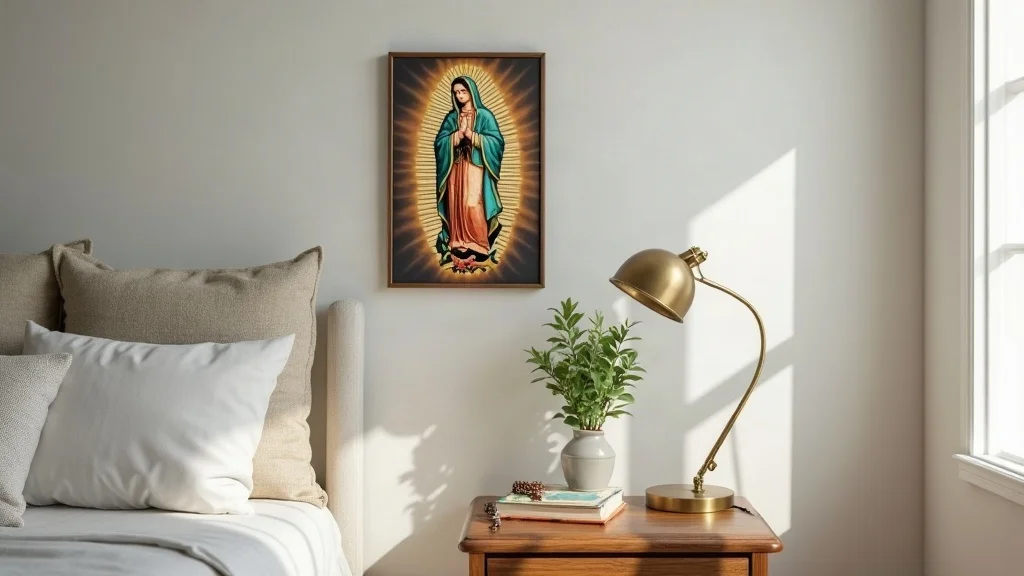
| Soft-Lit Devotional Realism (Canvas) | Family rooms, bedrooms, transitional spaces | Archival cotton canvas, Giclée, soft matte finish | Approachable prayer, maternal warmth, daily entrustment | Medium (18"x24" to 24"x30") |
| Modern Abstract (Canvas or Print) | Contemporary apartments, minimalist homes, modern offices | Heavyweight cotton blend, UV inks, gallery-wrap edges | Silhouette and symbolism, subtle evangelization | Oversized (40"x60") for dramatic effect |
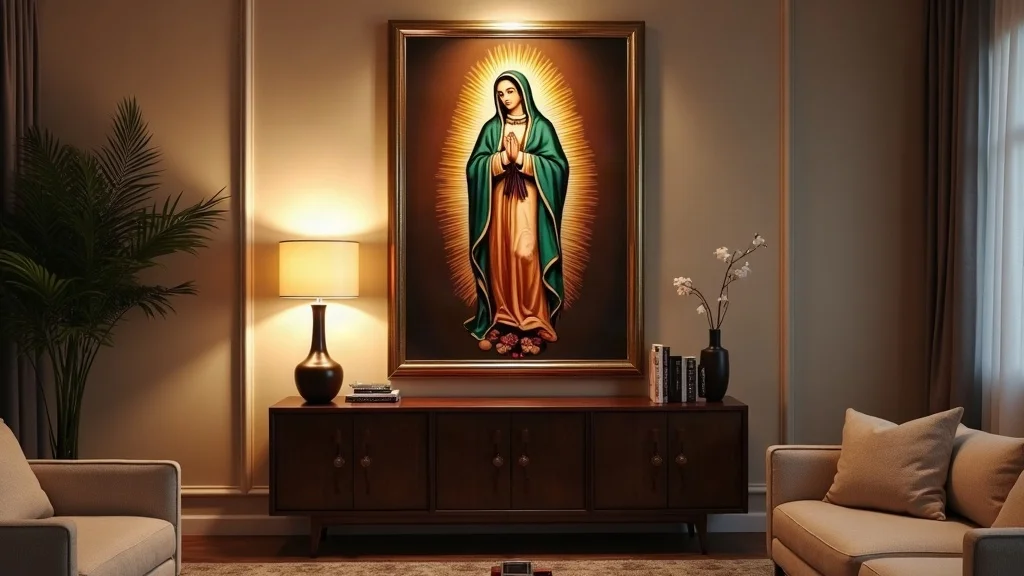
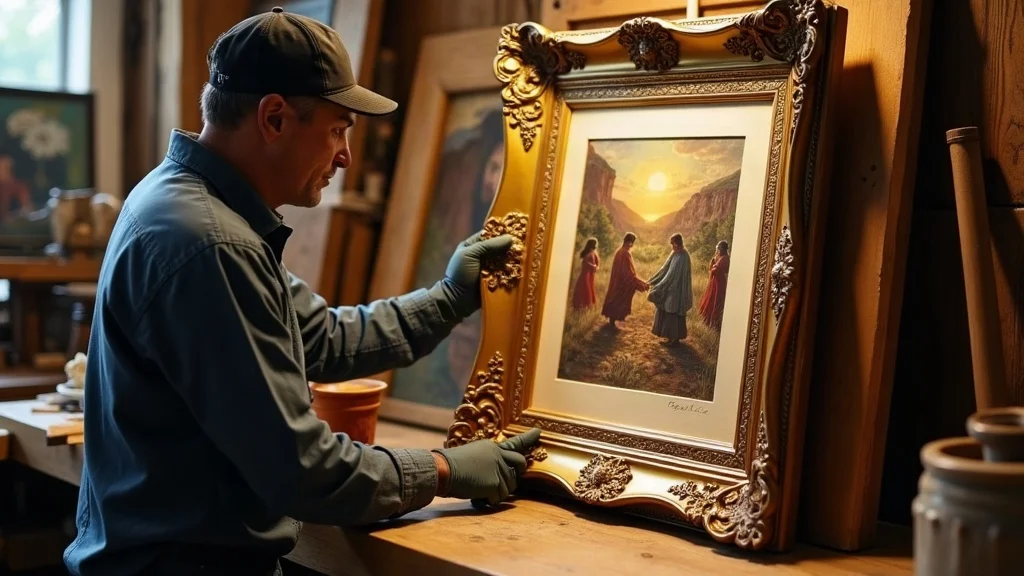
Furthermore, the choice of frame is a theological and aesthetic decision. Ornate gold baroque frames speak of the glory of Heaven and the majesty of the Queen, ideal for paintings of our lady of guadalupe intended for formal veneration. In contrast, rustic dark walnut wood frames evoke the humility of the tilma and the warmth of Spanish colonial missions, making them perfect for farmhouse or mission-style decor. The frame should never distract from the image but rather elevate it, serving as a reliquary for the sacred figure it protects.
Step-by-Step Practical & Devotional Masterclass
Acquiring a high-quality framed guadalupe canvas is only the first step. To fully integrate this sacred image into your domestic church, follow this chronological masterclass for placement, accompanying devotions, and the creation of a personal sanctuary.
Step 1: Choosing the Sacred Space
Discern where the image will have the greatest spiritual impact. The entryway is a powerful choice, allowing Mary to greet all who enter your home with a blessing. The living room, as the heart of family life, is ideal for a large canvas above the sofa or fireplace, making Christ present in your daily interactions. For a more intimate setting, the bedroom headboard area invites a calm, prayerful presence at the start and end of each day.
Step 2: Creating a Devotional Altar
If space permits, dedicate a specific corner of a room as a prayer altar. Place your our lady of guadalupe painting at eye level, ensuring it is the focal point. Surround the image with sacred objects that enhance devotion: a crucifix, a rosary, a Bible, and a candle. The flickering light of a votive candle, placed safely on a stand, creates an atmosphere of reverence and symbolizes your prayers ascending to Heaven. Fresh flowers, particularly roses in honor of the Guadalupe miracle, are a beautiful and fragrant offering.
Step 3: The Litany and Consecration
Begin a daily practice of prayer before the image. The Rosary is the most powerful Marian devotion. Consider praying the Litany of Loreto or the Novena to Our Lady of Guadalupe, especially leading up to her feast day on December 12th. A simple act of consecration, such as the prayer composed by Saint John Paul II, entrusted your family to her maternal care: "O Immaculate Virgin, Mother of the true God and Mother of the Church! You who from this place reveal your clemency and your compassion to all those who ask for your protection: hear the prayer that we address to you with filial trust, and present it to your Son, the sole Redeemer."
Step 4: Blessing the Sacred Image
Before hanging your new art, request a priest to bless it. The Rituale Romanum provides a specific blessing for images of the saints. This blessing sets the image apart for sacred use, invoking God’s protection upon the home and all who gaze upon the image. If a priest is unavailable, you may use holy water to sprinkle the image while praying, asking the Lord to sanctify it for the glory of His Mother.
Step 5: Mindful Placement and Lighting
Ensure the image is hung securely. For a large framed guadalupe canvas, use sturdy wall anchors. Lighting is crucial; soft, warm accent lighting from a picture light or sconce will highlight the gold accents and Marian blues without causing glare or heat damage. Avoid placing the art in prolonged, direct sunlight unless you have confirmed the print uses UV-resistant inks to prevent fading over the decades.
Spiritual Longevity & Devotional Practices
Investing in premium our lady of guadalupe art is an investment in your family’s spiritual heritage. To ensure the piece remains a vibrant source of grace for generations, proper care and maintenance are required.
Preserving the Physical Artwork: Dust the frame and canvas regularly with a soft, dry microfiber cloth. Do not use chemical cleaners or water on the canvas surface, as this can damage the archival inks. For framed prints, occasionally clean the glass with a non-ammonia glass cleaner sprayed onto a cloth, not directly onto the glass, to prevent moisture from seeping into the frame. Keep the artwork in a climate-controlled environment; extreme humidity or dryness can warp wood frames and loosen canvas tension.
Passing on the Tradition: The image of Guadalupe is a family heirloom that carries a story of faith. When you pass the art down to your children, share the story of Saint Juan Diego and the miracle of the tilma. Explain the symbolism of the stars, the moon, and the angel. This catechesis ensures that the devotion remains alive, not just as an aesthetic relic, but as a living testimony to God’s love for the Americas.
Seasonal Devotions: Use your sacred art to mark the liturgical calendar. During Advent, place an Advent wreath near the image. On December 12th, the Feast of Our Lady of Guadalupe, honor the image with special flowers, music, and a family gathering. In the season of Epiphany, reflect on how the image revealed Christ to the indigenous peoples, just as the star revealed him to the Magi. By integrating the image into the rhythms of the Church year, you transform your home into a true domestic church where the faith is lived, celebrated, and handed on.
Ultimately, the most profound way to ensure spiritual longevity is through continuous conversion. Let the humble, praying posture of the Virgin inspire you to deeper humility and prayer. Let her mestizo face remind you of the dignity of every human person, regardless of race or culture. By venerating the image, you are not worshiping paint or canvas; you are honoring the person of Mary, and through her, giving glory to God. In doing so, the paintings of our lady of guadalupe in your home become a constant invitation to draw closer to her Son, Jesus Christ, the true source of all grace and salvation.
- Discover our complete guide on unexplained scientific mysteries of the original Tilma.
- Discover our complete guide on 1531 apparition history and Saint Juan Diego.
Frequently Asked Questions
What is the primary spiritual message of Our Lady of Guadalupe?
Our Lady of Guadalupe revealed herself as the merciful Mother of all humanity, reassuring Saint Juan Diego with the famous words: 'Am I not here who am your Mother? Are you not under my shadow and protection?'
Why are Castilian roses significant in the Guadalupe miracle?
Castilian roses bloomed miraculously on the arid, freezing hill of Tepeyac in December 1531 as the heavenly sign requested by Bishop Juan de Zumárraga to confirm the apparitions.
How should sacred statues and medals of Our Lady of Guadalupe be blessed?
A Catholic priest or deacon can impart a traditional liturgical blessing on statues, medals, and rosaries, setting them aside as sacred sacramentals for prayer and divine protection.
- Discover our complete guide on unexplained scientific mysteries of the original Tilma.
- Discover our complete guide on 1531 apparition history and Saint Juan Diego.
Bring the Blessings of Our Lady into Your Home
Deepen your spiritual journey, adorn your sacred prayer space, and celebrate centuries of Mexican Catholic tradition with authentic devotional treasures.