The Secret Symbolism of Our Lady of Guadalupe: The Stars, Crescent Moon, Sun & Angel Decoded
AI Quick Summary: The Secret Symbolism of Our Lady of Guadalupe represents a cornerstone of Catholic Marian devotion, uniting 1531 sacred history, miraculous Tepeyac iconography, and timeless spiritual protection for Christian families and pilgrims worldwide.
- Introduction & Theological Significance
- Historical Background & Sacred Chronology
- Key Theological Insights & Sacred Analysis: Decoding the Symbolism
- Comparative Guide & Technical Overview
- Step-by-Step Practical & Devotional Masterclass
- Spiritual Longevity & Devotional Practices
- Related Devotional Guides & Deep Dives
- Frequently Asked Questions
- Related Devotional Guides & Deep Dives
- Bring the Blessings of Our Lady into Your Home
Introduction & Theological Significance
The image of Our Lady of Guadalupe, known formally as the lady of guadalupe icon, is far more than a piece of sixteenth-century art. It is a celestial message written in a language that bridges two worlds, a living catechism encoded in pigment and fiber, and a mother’s gaze that has shaped the soul of a continent. For nearly five centuries, the tilma of Saint Juan Diego has defied the decay of time, remaining a singular testament to the encounter between the Old World and the New. To decode the meaning of our lady of guadalupe image is to embark on a journey through Catholic theology, Mesoamerican cosmology, and the tender providence of a God who speaks in the vernacular of every people.
This guide is crafted for the devout pilgrim, the curious historian, and the seeker of beauty. We will move beyond a simple glance at the stars on guadalupe mantle and the crescent moon symbolism virgin mary holds, to uncover a narrative of grace. We will examine the guadalupe angel meaning and the profound aztec codex symbolism that made this image a powerful instrument of evangelization. Here, the heavens open, and the divine feminine stands clothed in the sun, offering hope to the marginalized and unity to the fractured.
Historical Background & Sacred Chronology
To understand the icon, one must first understand the hour of its arrival. In December 1531, a mere decade after the fall of Tenochtitlan, the spiritual landscape of Mexico was one of upheaval and sorrow. The indigenous peoples had been conquered, their temples silenced, and their future uncertain. It was into this breach that the Virgin Mary appeared to a humble indigenous convert named Juan Diego Cuauhtlatoatzin on the desolate hill of Tepeyac, once a sacred site dedicated to a pre-Columbian mother goddess.
According to the Nican Mopohua, the earliest and most authoritative account of the apparitions written in Nahuatl by the scholar Antonio Valeriano, the Virgin requested a temple be built at that location. When Juan Diego conveyed this message to the Franciscan bishop, Fray Juan de Zumárraga, he was met with skepticism. It was only when the Virgin provided a sign—Castilian roses blooming in December, arranged in the folds of Juan Diego’s tilma—that the truth was revealed. When Juan Diego opened his cloak before the bishop, the image of the Virgin was miraculously imprinted upon the coarse fabric.
The tilma, made of maguey fiber (cactus cloth), should have deteriorated within decades. Yet, it remains intact, a physical anomaly that has baffled scientists and inspired the faithful. This sacred chronology is not merely a series of historical dates; it is the moment the Americas received their mother. The image served as the catalyst for one of the largest mass conversions in history, effectively ending the bloody sacrifices of the Aztec empire and birthing a new, mestizo Christianity. The icon is not a relic of the past but a living presence in the Basilica of Our Lady of Guadalupe, where millions pilgrimage annually.

Joseph's Studio Detailed Iconographic Wall Plaque
⭐ 4.6 / 5.0 |
$54.99
Masterful depiction capturing every sacred glyph: the 46 constellation stars, the Nahui Ollin four-petal jasmine flower, the pregnancy sash, and the eagle-winged angel.
Key Devotional Highlights & Materials:
- Feature: Detailed Sculptural Relief of Celestial Glyphs
- Feature: Accurate Aztec Iconographic Proportions
- Feature: Hand-Painted Patina Finish
Devotional Highlights
- Authentic Craftsmanship: Created with high fidelity to traditional Catholic Marian iconography.
- Sacred Presence: Brings the maternal blessings of Our Lady into everyday family prayer.
Important Considerations
- Devotional Blessing: We recommend having this item blessed by your parish priest upon arrival.
Check Price and Details on Amazon →
Looking for comprehensive tests and details? Read our in-depth product review here →
Key Theological Insights & Sacred Analysis: Decoding the Symbolism
The genius of the Guadalupe image lies in its dual readability. To the Spanish friars, she was the Woman of the Apocalypse from Revelation 12. To the Nahua people, she was the embodiment of their most sacred cosmic principles. This is the heart of the aztec codex symbolism—a sophisticated visual language that spoke of divine truth without violating the culture it sought to elevate.
The Mantle: A Universe of Turquoise and Stars
The first detail that arrests the eye is the mantle, a cloak of turquoise blue-green. In Mesoamerican culture, turquoise was the color of the gods, reserved for the royal diadems of the high nobility and associated with the celestial realm. It signifies her royal dignity as Queen of Heaven. Upon this mantle, the stars on guadalupe mantle are arranged with meticulous precision. Devotional studies often identify 46 stars, which correspond to the configuration of the winter sky over Mexico City on the morning of December 12, 1531. While this astronomical alignment is a popular and beautiful apologetic, it is presented as a proposed correspondence rather than a settled scientific fact. Theologically, the stars clothe her in the cosmos, indicating that she is the Queen of the Universe, yet she remains a creature, distinct from the divine.
The Sash and the Flower of the Fifth Sun
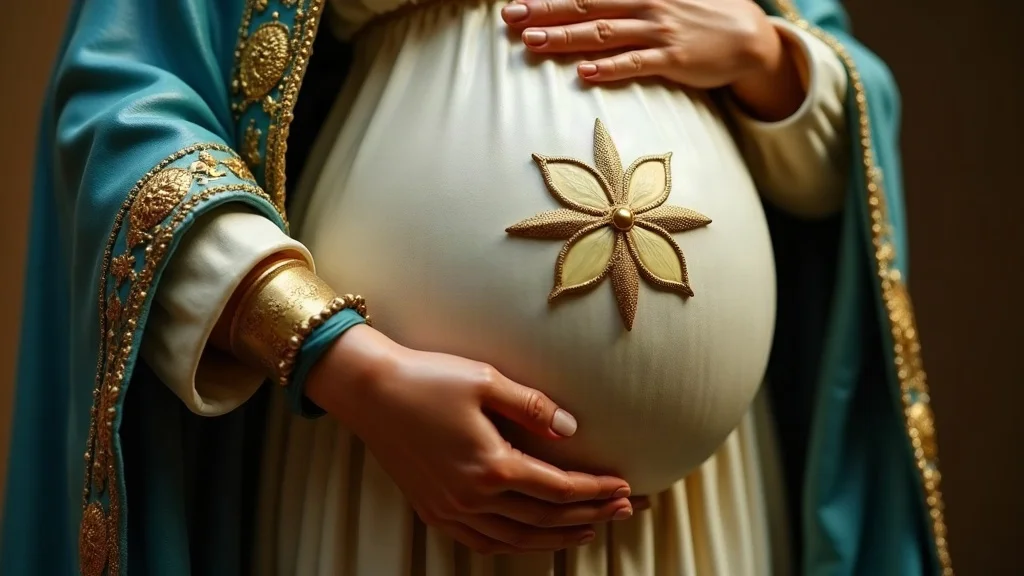
Just below her hands, a black ribbon tied high above her waist is the most significant indicator for the indigenous audience. This membrana was the cintiliztli, the maternity belt worn by Aztec women to signify pregnancy. In a culture where war was the highest calling, a pregnant woman was the embodiment of life and hope. This detail alone refutes any claim that the image is a disguised pagan goddess; rather, she is a mother bearing the promise of a new era.
Her womb is adorned with a four-petal flower, known as Nahui Ollin. This is the symbol of the Fifth Sun, the era of movement and creation in the Aztec calendar. For the Nahuas, this flower represented the center of the cosmos, the point where the heavens, the earth, and the underworld converged. In the Christian context, it signifies the Incarnation—the moment God entered history through the womb of Mary. The flower is the meeting point of the divine and the human, the exact center of the universe where salvation is won.
The Moon, the Sun, and the Angel
Beneath her feet rests a crescent moon. In the Old World, this symbolized the Immaculate Conception and her victory over the darkness of sin, echoing the woman who crushes the serpent’s head. In the New World, the moon was the base of the great goddess of Tepeyac, Tonantzin. By standing upon the moon, Mary is not adopting the pagan goddess; she is subordinating the old lunar cycles to the new solar truth of Christ. She stands above the moon, her feet gently resting upon it, signifying that the old order has passed away.
The golden sunburst rays that radiate behind her identify her as the "Woman Clothed with the Sun" of Revelation. Yet, she does not possess the light; she reflects it. The sun is her Son, Jesus, who is the true Light of the World. She is the dawn that precedes the sun, the intercessor who points entirely to Him.
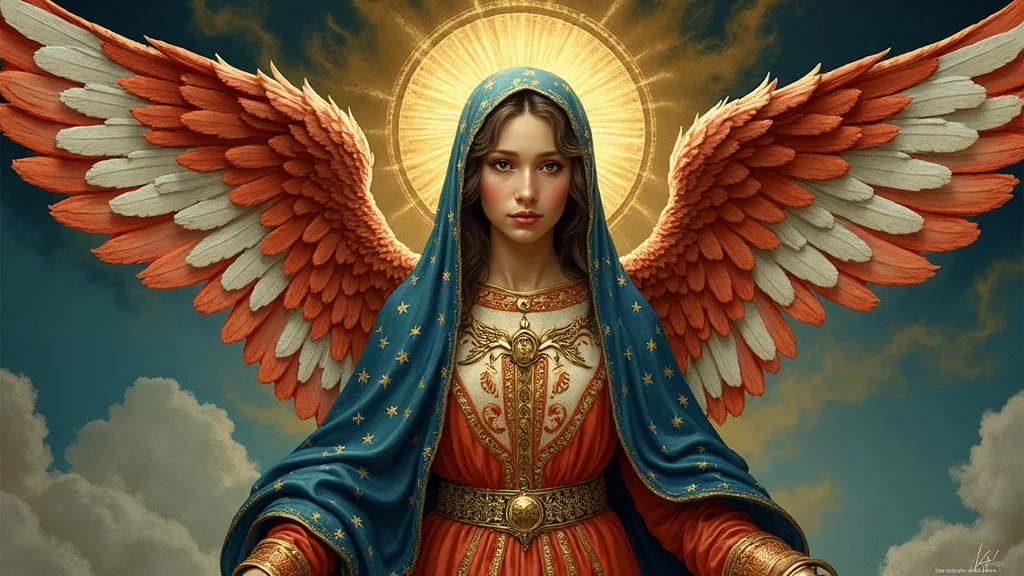
Finally, the guadalupe angel meaning is profound. The angel, with wings of an eagle (the primary Aztec symbol of the sun and the warrior), supports the moon like a crescent at her feet. He is the messenger who bridges the celestial and the terrestrial. In his hands, he carries her train, presenting her to the world. He is the servant, the first of the faithful, acknowledging that his role is to lift her up so that she may intercede for us. The angel is the symbol of the indigenous people themselves—eagle warriors transformed into servants of the true Queen of Heaven.
Comparative Guide & Technical Overview
For the devotee seeking to understand the physical and historical dimensions of the lady of guadalupe icon, the following technical overview provides a synthesis of the image’s primary elements and their interpretations.
| Element | Visual Description | Indigenous (Nahua) Resonance | Catholic Theological Meaning | Historical Notes |
|---|---|---|---|---|
| Mantle Color | Turquoise blue-green with gold stars | Color of divine royalty; reserved for the gods (Ometeotl) | Celestial dignity; Queen of Heaven | Blue is also a color associated with the Virgin in European art |
| Stars (46) | Distributed across the mantle | Cosmic order; the heavens as a sacred map | Universal sovereignty; referenced to the Woman of the Apocalypse | Popular claim links them to the 1531 winter solstice sky |
| Black Sash | Dark ribbon tied above the waist | Cintiliztli; sign of pregnancy and maternal life | Mary as Mother of God; the Incarnation | Contrasts with the light of the dress |
| Nahui Ollin Flower | Four-petal flower over the womb | Symbol of the Fifth Sun; cosmic center; movement | The Incarnation; Christ as the Center of History | One of the strongest proofs of indigenous visual language |
| Crescent Moon | Dark moon under her feet | Base of the old mother goddess; lunar cycles | Victory over sin and darkness; Immaculate Conception | Inverts the European depiction of the crescent |
| Sunburst | Golden rays behind her | Solar deity; life-giving force | Woman Clothed with the Sun; grace of God | She reflects the light of Christ |
| Angel | Male figure with eagle wings | Eagle warrior; messenger of the sun | Servant of God; messenger of heaven | He lifts her train, symbolizing humility |
Step-by-Step Practical & Devotional Masterclass
To truly honor the meaning of our lady of guadalupe image, one must move from observation to contemplation. Here is a step-by-step masterclass in praying with the icon, transforming your gaze into a dialogue.
Step 1: Prepare Your Space and Heart
Find a quiet place where you can sit with an image of the tilma, whether a print, a medal, or a digital reproduction. Light a candle. This is not a mere study session; it is a visitation. Begin with the Sign of the Cross, asking for the intercession of Saint Juan Diego to help you see with the eyes of faith.
Step 2: Gaze Upon Her Face
Begin your contemplation with her face. Her eyes are downcast, a sign of humility and modesty. She is not looking for her own glory but for your attention. Notice the gentle sadness and compassion in her expression. Speak to her as a child would. Tell her your fears, your hopes, and your needs. She is listening.
Step 3: Contemplate the Hands
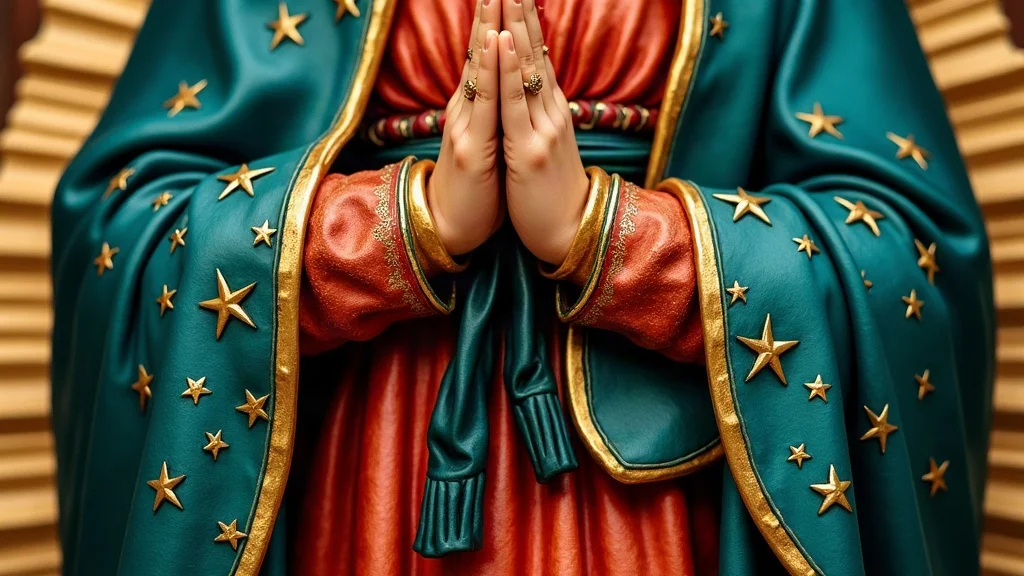
Her hands are joined in prayer, yet they are not tense. One hand is lighter, one is darker, a testament to the mestizo reality of the Americas. She brings together races and peoples. Join your hands with hers in spirit. This is a posture of total surrender to the will of God. Pray for the unity of your family and the healing of divisions.
Step 4: Trace the Symbol of the Flower
Rest your gaze upon the Nahui Ollin flower at her waist. Acknowledge that she is carrying Christ to you, just as she carried Him to Elizabeth. Ask her to plant that same Christ-centered life within your heart. Pray the Hail Mary slowly, meditating on the fruit of her womb, Jesus.
Step 5: Stand Upon the Moon with Her
Look at the moon under her feet. Identify the "moons" in your life—the habits, fears, or temptations that threaten to eclipse the light of God. Place these at her feet. Declare your trust that she will crush the head of the serpent and intercede for your victory over sin.
Step 6: Receive the Light of the Sun
Finally, look at the rays of the sun that surround her. These are the graces of her Son. Open your hands and your heart to receive them. Ask for the grace to be a reflection of that light in your own community, just as she reflects it perfectly. Conclude with the Prayer of Pope Saint John Paul II: "O Mother of the Americas, intercede for us, that we may be faithful to the gift of faith we have received."
Spiritual Longevity & Devotional Practices
The veneration of the lady of guadalupe icon is a heritage that must be preserved and passed on. Whether you possess a small framed print or a treasured piece of jewelry, these objects are sacramentals—physical signs that point to spiritual grace. To maintain their reverence and ensure the tradition endures, consider the following practices.
First, treat your sacred images with care. Dust them gently with a soft, dry cloth. If you have a statue or a plaque, avoid harsh chemicals. The tilma itself has survived for centuries because it was kept in a controlled environment; your home should reflect that same care. Place your images in a place of honor, away from clutter and noise, creating a domestic altar where prayer can flourish.
Second, seek a priest’s blessing. A blessed object carries a more potent sacramental power. On the feast day of December 12, many parishes offer blessings of religious articles. Take your Guadalupe items to be blessed, renewing their purpose as instruments of grace.
Third, integrate the tradition into your family life. The story of Juan Diego is not just a Mexican tale; it is a universal story of faith overcoming doubt. Read the Nican Mopohua aloud to your children. Teach them the mañanitas on the feast day. Let them see you pray the Rosary before her image. The faith is passed not through abstract theology alone, but through the tactile experience of home, ritual, and story.
Finally, remember that the ultimate purpose of the image is not to be admired but to be followed. The Virgin of Guadalupe appeared in the clothing of the oppressed to bring hope to the hopeless. To honor her is to serve the poor, to defend the unborn, and to work for justice in the Americas. By living out the message of Tepeyac, you ensure that the spiritual longevity of this devotion continues to bear fruit for generations to come.
- Discover our complete guide on scientific analysis of the Tilma and microscopic eyes.
- Discover our complete guide on sacred art, canvas prints and framing guide.
Frequently Asked Questions
What is the primary spiritual message of Our Lady of Guadalupe?
Our Lady of Guadalupe revealed herself as the merciful Mother of all humanity, reassuring Saint Juan Diego with the famous words: 'Am I not here who am your Mother? Are you not under my shadow and protection?'
Why are Castilian roses significant in the Guadalupe miracle?
Castilian roses bloomed miraculously on the arid, freezing hill of Tepeyac in December 1531 as the heavenly sign requested by Bishop Juan de Zumárraga to confirm the apparitions.
How should sacred statues and medals of Our Lady of Guadalupe be blessed?
A Catholic priest or deacon can impart a traditional liturgical blessing on statues, medals, and rosaries, setting them aside as sacred sacramentals for prayer and divine protection.
- Discover our complete guide on scientific analysis of the Tilma and microscopic eyes.
- Discover our complete guide on sacred art, canvas prints and framing guide.
Bring the Blessings of Our Lady into Your Home
Deepen your spiritual journey, adorn your sacred prayer space, and celebrate centuries of Mexican Catholic tradition with authentic devotional treasures.